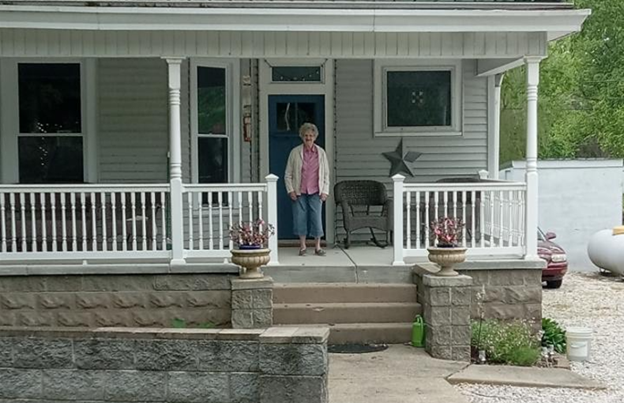
Jo Phelps in front of her grandparent’s home in Hazleton, where she lived as a young girl during the Great Depression
It was a bright, breezy early summer day. I was sitting in the front room with Jo and her great niece, Jamie Beyer. A Chickering grand piano, once owned by Jo’s grandmother, was across the room near the picture window where the sunrays were peeking through.
Outside, the wind was rustling through the four tall, stately trees that framed the front of her home, overlooking a small, overgrown pond tucked into the woods. Her dog, Hadley, sat next to her on the couch as I took a seat in a nearby recliner while Jamie moved a chair into the middle of the room. As we settled into small chit chat, Jo joked with me that the “interrogator” had arrived. Minutes later, she plunged into the story of how she came of age as the world was coming undone.
Born at Good Samaritan Hospital in Vincennes, Indiana on July 11th, 1928, Jo and her family lived in the small town of Hazleton situated on the White River, less than twenty miles south of her birthplace in Vincennes. Little over fifteen months after she was born, the stock market crashed and families like the Caniff’s were plunged into a state of despair. Shortly thereafter, her father lost his job at the oil fields. The family moved out of their rental house and in with Jo’s grandparents, soon to be joined by their aunt Pearl and her three children. Pearl’s husband went East for work never to return. It was a tragic story that would be recreated many times across the US in the 1930’s.
Fortunate that Jo’s grandfather retained his job at the grain elevator, three families were suddenly thrust together as were many in this small, previously vibrant town. Cousins suddenly became siblings, and grandparents were thrust into a parenting role. As Jo joked, there was “always someone to fight with.” Yet amid dire times, Jo distinctly recalled a sense of solidarity in the town that belied the dark days. The Caniff family lived four blocks from the river, ever a source of entertainment and sustenance. “It was free, and we swam, fished, and did whatever. The catfish were big. We ate what was there, and we thought it was wonderful. I still love fried catfish even today.”
As Jo recalled, families organized fried fish parties on the riverbank, as the waterway became as much of a social scene as it was one for survival. But it wasn’t just fish on the menu. “We ate squirrels, rabbit, whatever we could find — we were lucky to have food and never complained.” Meanwhile, kids “ran the streets” and parents and families looked out for each other. “I don’t ever remember people getting hurt. People did what they could” she matter-of-factly noted, and “no one had anything. Our clothes came from others. Nobody cared.”
As the Depression continued, her mother decided to go to college during the summers in Terre Haute to get her teaching degree having previously worked in a tomato canning factory and giving music lessons. Jo accompanied her during this time, and initially as a young child, was left in the apartment while her mother went to school. Jo possessed an early streak of fearlessness, which was “part of my problem.” Shortly after arriving in Terre Haute, while her mother was in class, Jo left the apartment and went down to a rough part of town where she saw other kids playing. “They beat me and tore my clothing.” It was the last time her mother left her home alone, from then on taking her to class with her. Her mother eventually earned her bachelor’s degree, but came back home only to find that as a registered Republican in a Democratic town, she was unable to obtain work at the local school. This only changed years later after Jo’s father passed, and the principal approached her with a proposition: register as a Democrat no matter what your political leaning and I will give you a job. And so her mother did and the job was hers.
In late 1941, Jo and her classmates were called into the gym by the principal. ‘I’ll never forget what he said” speaking with an evident air of gravity over eight decades later. Simply stated, he told the students “We are at war.” It was a “scary” time as the Depression had suddenly given way to the war to end all wars. Later the next summer, Jo met a young man from New Harmony at a summer camp by the name of Porter Stallings, who as she sheepishly noted became her boyfriend “after he put his arm behind me on the church bench.” Like many people back home, she began writing to Porter, who had gone overseas as a private in the Army. One day, she and a friend went to the Hazelton Post Office only to find that her letter to Porter had been returned with the initials KIA [Killed in Action] written on the envelope. “I never forgot his name.”

As high school progressed, and the war continued, Jo took a summer job in Vincennes, riding a bus from Hazelton. She lied about her age to get the job, but as she explained, “No one at that time really cared” as long as you did the work and did it well. On the way home one particular evening, a serviceman on the bus gave her tickets to a dance club in Princeton. Jo grinned. “I loved to dance and three of us girls got in the car” and headed up to the club soon thereafter, where a band was playing that night. “We knew we didn’t belong, with our bobby socks and everyone being older, but we didn’t care.”
As her friends started to dance with others, a military man by the name of John Woods from Palestine, Illinois came up to her table and asked if she liked to dance. He was four years older than her, but it was immediately clear they liked each other. By the end of the evening, John asked if he could date her sometime. “You’ll have to come meet my parents” she recalled saying. John was still in the Navy having come home after seeing significant action on the eastern front. The year was 1944. He was attending DePauw University after being commissioned as an officer, later transferring to Purdue University for engineering before graduating from the University of Illinois in Champaign.
One or two dates later, John and Jo were coming home late from Vincennes and Jo knew she would be in “big trouble” as they were set to arrive past curfew. As they were driving home, John told her that he “would like to see her again on Saturday night” to which she replied, “You’ll never see me again after I get home way past when I should be.” When they arrived at the Caniff home, they walked inside. John immediately apologized to Jo’s parents for bringing her past curfew. Oh, and one other thing, John said. “I am going to marry your daughter [someday]” “I was aghast”, Jo said. “I ran upstairs, I couldn’t believe what he just said. I wasn’t in any mood to be thinking about marriage. I just wanted to go to those dances.”
Pat, Jo’s father, told John, “You are a blowhard” and then just laughed. But over time Jo noted, “Dad not only forgave him but came to like him” and so did her mom. As Jo sat on her sofa reflecting on this moment many decades prior, she softened and noted that for all that John and others had experienced during the war and the Depression, it wasn’t so incomprehensible that he would say this as we might think today. “They [soldiers] just wanted to settle down and have a stable existence.” Like others, John just wanted someone he could “trust” that could bring about a sense of normalcy that many of this generation hadn’t felt. Committing to someone for life and settling down was the easiest way to do this; fears related to commitment seemed miniscule compared to the fears that they had already encountered.
Over the next few years, Jo and John continued to correspond by letters, occasionally seeing each other in person while encouraging each to date as they desired. Yet John persisted in his original stance that someday, he would marry this gal. Jo eventually graduated high school and enrolled in nursing school at Deaconess Hospital in Evansville, Indiana. Like most student nurses at that time, she lived in a small commune a block or so from the hospital, where curfews were strictly enforced using a sign in, sign out system. After graduating from the University of Illinois, John got a job in Evansville, and from there the courtship took off. “I had no idea he was moving down there [Evansville] until finding out that he had an apartment nearby where we lived.”
They were married in September of 1949 after Jo graduated from nursing school. In 1951, her father died of stomach cancer. “I was right there taking care of him when he died.” Soon after, Jo got pregnant with her first child, Tommy. Still in the active reserves, John got orders to ship out and was eventually placed on the naval base in Key West, Florida, where the family relocated three weeks after Tommy was born. The Korean Conflict was underway, and Russian and American subs were playing a dangerous game of “tag” just off the Florida coast. Jo recalled, “The subs could see each other underwater. It was a dangerous time.” Filled with military personnel and their families, there was no room on the base and the Woods family was placed in a small trailer park nearby. Jo recalled wondering, “Is life always going to be this way?” Are we ever going to stop moving and have any stability? But in recalling her state of mind, she stated, “We didn’t have time to think about things – we just had to do it.”
Now a Navy wife, Jo remembered the camaraderie that existed with the other wives and the way that all their needs were taken care of. “It was an easy life.” The Navy hospital was right there, and various other amenities were nearby. “They asked me to work [as a nurse], but “I just wanted to be at home when my husband got home.” She just wanted to be a wife and mother.
But while life as part of the Navy family was mostly good, Jo distinctly remembered how the townspeople “wanted nothing to do with us.” She described an experience of going to St. Mary’s Star of the Sea (enshrined as a minor basilica in 2012). “I went by myself and left by myself.” It was an experience and an overall feeling that never left her. “I learned from that.” she emphatically stated. “You need to welcome people you don’t know. It is something that I have tried to do throughout my life whether it is a smile, a friendship, a cup of coffee.” Later, when the Navy moved out of Key West, her husband was approached about taking a job in town. “Maybe if people had made me feel welcome, I would have pushed him to stay…” It was not to be.
The Woods family returned home, and having moved several times in Evansville before and after John’s appointment in Key West, they finally relocated for the final time in 1959 to the bucolic estate where Jo lives today. They would have eight kids in total. John and Jo were married for almost 45 years before John passed away in 1994. Jo remarried Bill Phelps in 2016 and he passed away ten years later.
Sitting there with Jo, it was easy to be enthralled with her remarkable sense of lucidity and recollection. Still, it was the resilient, adventurous spirit that struck me the most; through almost a century of life, she was still the little girl swimming and fishing in the White River, dancing her way through the Great Depression. She seemed to possess an uncanny ability to find the good in the hard times, joy in the uncertain ones, and to recognize the bad as an inherent part of life rather than something to bemoan. Having come of age during a time of great turmoil, she found little use in complaining and many reasons to embrace the opportunities that life had brought, sometimes just to stay alive. When the demands of life became overwhelming, her mantra was simple “God, I can’t handle this, and I give it to you.” But as we talked more, it was clear that her submission was anything but passive. “I constantly think about what to say, what not to say, how to say it, how to do it, what I should do…And then I have to do it. I can’t expect that God is going to do it for me.” Deeply grounded in her faith, it was the degree of intentionality and care that showed through her like the rays of sunshine peeking in her front window, illuminating the worn ivory keys on the grand piano that she still plays.
As we wrapped up the interview, having just met her for the first time, Jo invited me and my family to come back anytime to go swimming and fishing in the lake out front. Jamie gave her a hug as each expressed their love for the other. Having just shared nearly a century of perspective, she was still forging new relationships, reveling in those she had, and looking forward to what the future would bring. The following day, she and her son, Rick, were headed back to multiple cemeteries and other spots of interest near her childhood home to lay flowers on graves in advance of Memorial Day. It was going to be a busy schedule of travel and reminiscing, which Jo described to us as we were preparing to leave. When Jamie mentioned out of care that it would be a full day, Jo smiled at her, and with a slight wink, said, “I’ll be fine.”

3 thoughts on “Nearly a Century of Perspective”
Thank you for this interview with Jo (Woods) Phelps. I attend St. James Catholic Church as my parents now deceased( my mother and her parents) also attended St. James Catholic School and Church as well as myself. I knew John Woods as he was our DRE and I taught CCD under him for several years here at St. James. I never knew of their meeting but could so relate to them as my parents lived through this era and my father served in the U.S. Navy . Thank you for sharing this story of Jo Phelps. She is truly a wonderful lady!
My husband served in the U.S.Army during the Vietnam War and I lived with him while he was stationed in W. Berlin, Germany. While we were there, his brother. Larry, was a pilot and was shot down in N. Vietnam. At first listed as KIA, then MIA/POW. Eventually many years later his remains were found.
I have been reading several books lately in reference to past wars and though I knew so many lives had been lost or forever changed by those devastating times, I find it to be so humbling how many people were forever changed because of them.
Again, thank you for such a good read!
Very interesting lady. I attend St James where Jo is a member.
What a heartwarming story you’ve shared with all of us who know and deeply admire our Jo Woods Phelps! Thank you so much Dr. Schroeder! Jo is so precious to me as a dear friend and mentor with our St. James choir. It will come as no surprise to you that Jo still plays the organ at Sunday Mass on occasion. I will share this with family and friends…Jo’s resilience and faith throughout her life’s joys and challenges are examples for all.